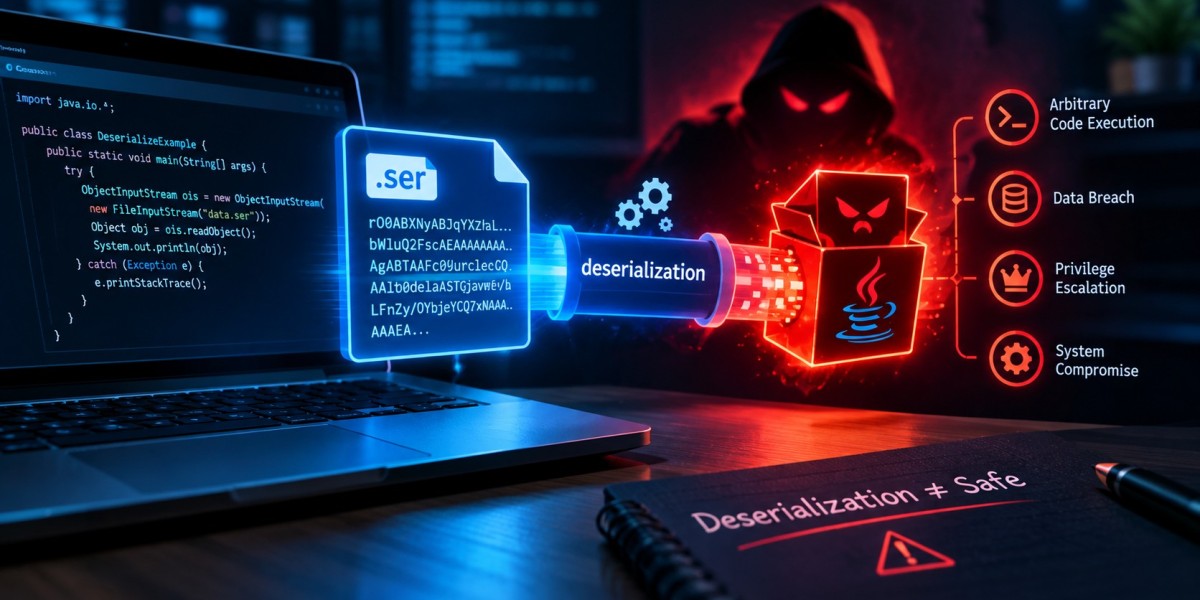

At enterprise scale, a Java deserialization attack is not a single engineering problem; it is a portfoliowide risk that requires policy, dependency governance, and automated gating across every service that touches Java object serialization. A single fixed endpoint tells you almost nothing about your organization's actual exposure when you have hundreds of services, dozens of teams, and a shared dependency ecosystem where one vulnerable library can reintroduce the same gadget chain in a dozen unrelated applications simultaneously.
Security leaders who have dealt with a serious Java Deserialization Vulnerability object deserialization attack in production usually describe the same pattern afterward: the vulnerable code was not unusual, the team that owned it was not negligent, and the fix itself was straightforward once found. What made the incident possible was the absence of a program that would have caught the pattern before it shipped, anywhere in the organization. This guide is about building that program.
Why This Vulnerability Class Demands PortfolioLevel Thinking
A single insecure deserialization vulnerability can be fixed by one engineer in an afternoon. The risk at enterprise scale comes from scale itself.
The SharedDependency Problem
Gadget chains live in libraries, not in application logic, and large organizations tend to share a common set of foundational dependencies across many services: the same logging framework, the same collections library, the same ORM. When a new gadget chain is discovered in a widely used library, it doesn't affect one team's codebase; it potentially affects every service across the portfolio that has that library on its classpath, whether or not that service's developers have ever touched a line of deserialization code themselves. This is fundamentally different from most applicationlevel bugs, which stay contained to the service where they were introduced.
Why TeambyTeam Remediation Does not Scale
If your organization's only response to a discovered Java deserialization vulnerability is the owning team fixes it, you will consistently find the same class of issue resurfacing in different services over time, because each team is solving the problem locally without a shared understanding of the underlying pattern, and without central visibility into which other services share the same exposure. Enterprise scale remediation requires knowing, at a portfolio level, which services deserialize untrusted input at all, and which specific libraries with known gadgetchain history are present across that population of questions no individual team can answer on its own.
Building the Program Four Pillars
An effective enterprise response to this risk area rests on four connected pillars, each owned differently but coordinated centrally.
Pillar 1 Policy and Standard
Start with a written standard that states, unambiguously, the organization's default posture native Java serialization is not permitted for any data crossing a trust boundary unless an explicit, documented exception has been granted. This single policy statement does more to reduce risk than any tooling investment, because it shifts the default from allowed unless flagged to disallowed unless justified. The standard should also mandate ObjectInputFilter allowlisting for any approved exception, and require that exceptions be reviewed on a defined cadence rather than granted permanently. This policy sits alongside the organization's broader web security best practices documentation and should be referenced from onboarding material for every engineering team, not buried in a security wiki nobody reads.
Pillar 2 PortfolioWide Dependency Visibility
You cannot govern what you can not see. A software composition analysis (SCA) program that inventories every services dependency tree, flags known gadgetsource libraries (Apache Commons Collections, vulnerable Spring versions, certain Hibernate releases, and others as they're discovered), and tracks that inventory centrally is the single most important technical investment in this program. This is not a one time scan, it is a continuously updated view, because new services launch, dependencies get bumped, and new gadget chains get published in libraries nobody had flagged before.
Program Maturity Level | Dependency Visibility | Typical Outcome |
Ad hoc | No central inventory; each team tracks its own dependencies | New gadget chains discovered reactively, often during an incident |
Managed | Periodic portfoliowide dependency scans | Known vulnerable libraries found and patched, but with lag |
Mature | Continuous SCA integrated into CI/CD with automated alerts | New gadget source disclosures trigger same day portfolio queries |
Pillar 3 CI/CD Gating
Policy without enforcement is a suggestion. Integrate static analysis rules flagging ObjectInputStream.readObject() usage, custom readObject() overrides, and known gadgetsource dependencies directly into the CI/CD pipeline, with a buildbreaking gate for new instances introduced without a documented exception. This is where a written policy becomes an enforced control rather than a document teams are expected to remember on their own. Pairing this with SCA gating on dependency additions closes the loop new code and new dependencies are both checked automatically before they reach production, not discovered afterward during a scheduled secure code review cycle.
Pillar 4 Verification Through Testing
Policy, visibility, and gating tell you what should be true. Testing tells you what actually is. A recurring program of web application security testing across your highest risk services handling untrusted external input at internet facing endpoints validates that your controls are holding in practice, not just on paper. This is also where centralized offensive expertise pays for itself rather than every team independently learning how to build and run gadgetchain payloads, a shared security testing function using established penetration testing tools can test across the whole portfolio with consistent methodology and comparable results.
Governance Who Owns What
A program only functions if ownership is explicit. The most common failure mode in large organizations is not a lack of tooling, it is ambiguity about who is accountable when a new gadgetsource library is disclosed.
Central Security Team Ownership
The central AppSec function should own the written policy, the portfoliowide dependency inventory, the CI/CD gating rules, and the response process for newly disclosed gadget chains including the ability to query, on short notice, which services across the organization are affected by a newly published disclosure. This centralized capability is what turns a public gadgetchain disclosure from an open ended scramble into a sameday, scoped response.
Individual Team Ownership
Engineering teams own remediation within their own services, adherence to the policy for any new deserialization adjacent code they write, and participation in the exception process when native serialization is genuinely required. The division of labor matters central teams can't remediate code in a hundred different services, but they can make sure every team knows the standard, has the tooling to check their own code against it, and understands the escalation path when something is found.
Risk Acceptance and Exceptions
Not every legacy system can be migrated off native serialization immediately. A functioning program needs a formal, timebound exception process not a silent exemption that never gets revisited. Every exception should specify the isolation control in place (an internal network boundary, an allowlist, a planned migration date) and come up for review on a fixed schedule, so risk acceptance decisions don't quietly become permanent by default.
Vendor and ThirdParty Risk
Large organizations rarely run only internally written Java services; commercial application servers, middleware, and CI/CD tooling are frequently part of the same attack surface, and several of the most severe publicly disclosed Java deserialization incidents have involved exactly this category of third party software rather than custom application code. A mature program extends its dependency visibility and disclosure response process to vendor software as well, tracking which third party products in the environment are built on Java and maintaining a subscription to relevant security advisories so a disclosure affecting a vendor product triggers the same same day impact assessment as one affecting an internally maintained library. Procurement and vendor risk assessment questionnaires should explicitly ask about deserialization handling for any Java based product being brought into the environment, rather than treating this as a question only relevant to internally built software.
Incident Response Considerations Specific to This Vulnerability Class
When a Java deserialization attack succeeds, the resulting compromise typically grants the attacker code execution with whatever privileges the vulnerable service runs under, often more than a typical data exposure incident would provide. Incident response playbooks should account for this specifically confirming whether a suspected deserialization compromise resulted in lateral movement from the initially affected service is a higher priority step here than it might be for a lower severity finding, precisely because the initial foothold tends to be more powerful. Response teams should also be prepared to identify which gadget chain and which library version were involved as part of root cause analysis, since that detail determines whether other services sharing the same dependency are also at risk and need immediate assessment, not just the one service where the incident was detected.
Measuring Whether the Program Is Working
Security leadership needs metrics that reflect actual risk reduction, not just activity.
Percentage of services with a completed dependency inventory you can't manage exposure you haven't measured.
Number of active, unreviewed exceptions to the nonnative serialization policy a growing number here signals the exception process has become a loophole.
Time from new gadgetchain disclosure to portfoliowide impact assessment should shrink toward the same day as your SCA tooling matures.
Findings from recurring security testing tied specifically to insecure deserialization a downward trend over successive testing cycles is the clearest signal the program is actually reducing exploitable risk, not just paperwork risk.
This vulnerability category sits within the broader landscape covered in the OWASP Top 10, and framing your program metrics against that shared reference point makes it easier to communicate progress to stakeholders who think about risk in terms of established industry categories rather than internal tooling details.
Benchmarking Against Other InputTrust Vulnerability Programs
Most mature security organizations already run a comparable governance model for other input trust vulnerability classes, and it's worth benchmarking your deserialization program against whichever one is furthest along SQL injection governance, since it tends to be the oldest and most institutionalized. The parallels are close enough to be useful both require a written standard, both benefit enormously from automated detection integrated into the build pipeline rather than relying on manual review, and both need a portfoliowide view because the same unsafe pattern tends to repeat across unrelated services built by different teams at different times. If your organization already has a wellrun program for one of these categories, borrowing its governance structure, reporting cadence, exception process, executive dashboard format for deserialization risk will get you to a working program considerably faster than designing one from scratch.
Building Internal Expertise, Not Just Tooling
Tooling and gating reduce risk mechanically, but a program is far more resilient when engineers across the organization genuinely understand this vulnerability class rather than just following a checklist generated by a scanner. Structured, handson training closes that gap faster than documentation alone. AppSecMaster source code review labs give engineering teams practice identifying this exact pattern in realistic code, and the web security CTF challenges let internal security champions experience the attacker's side firsthand which consistently produces better code review outcomes than reading about web application security threats in the abstract. A broader web application hacking rotation is also worth including in any internal security champion program, since it builds the endpoint/discovery instincts that make a deserialization specific lab far more effective once a team gets their champions who already know how to map an application's attack surface get more out of a focused gadgetchain exercise than those encountering both skills for the first time at once. If your engineering organization is earlier in this maturity curve and needs the foundational technical reference before building policy around it, the detailed Java Deserialization Vulnerability guide covers the exploitation mechanics your policy is designed to prevent, which is useful context for briefing engineering leadership on why the standard exists in the first place.
Conclusion
Managing Java deserialization risk across an enterprise portfolio is fundamentally a governance problem wrapped around a technical one. Any single team can fix a single vulnerable endpoint, but only a coordinated program clear policy, portfoliowide dependency visibility, automated CI/CD gating, and recurring verification testing prevents the same pattern from resurfacing across a hundred different services as new gadget chains are discovered over time. Organizations that treat this as a onetime remediation project rather than an ongoing governance function tend to relearn the same lesson during their next incident.For organizations building a training rotation across multiple vulnerability classes, the full challenge library covers this alongside related categories, and the homepage outlines every current track available for teamwide rollout.
Frequently Asked Questions (FAQs)
Why can not individual engineering teams handle this risk on their own?
Gadget chains live in shared dependencies, so a vulnerability discovered in one library can affect dozens of unrelated services simultaneously. No individual team has visibility into which other services share that exposure that requires a centralized dependency inventory and coordinated response process.
What is the most important first investment for a new program?
Portfoliowide dependency visibility through software composition analysis. Without knowing which services use which libraries, you can't scope your exposure when a new gadget chain is disclosed, and every other pillar of the program depends on that baseline.
Should exceptions to a nonnative serialization policy ever be permanent?
No. Exceptions should be timebound and reviewed on a fixed schedule, with a documented isolation control in place. A permanent, unreviewed exception tends to become a silent gap that resurfaces during an incident or an external audit.
How do we measure whether our program is actually reducing risk?
Track dependency inventory completeness, the number of active unreviewed exceptions, response time from a new gadgetchain disclosure to a portfoliowide impact assessment, and findings trends from recurring security testing. A downward trend in testing findings over successive cycles is the strongest signal of real progress.
Does CI/CD gating alone solve this problem?
No. Gating enforces the policy going forward for new code, but it doesn't retroactively find existing risk in a large, established codebase or account for gadget chains discovered later in libraries already deployed. It needs to be paired with dependency visibility and recurring testing to cover the full risk picture.