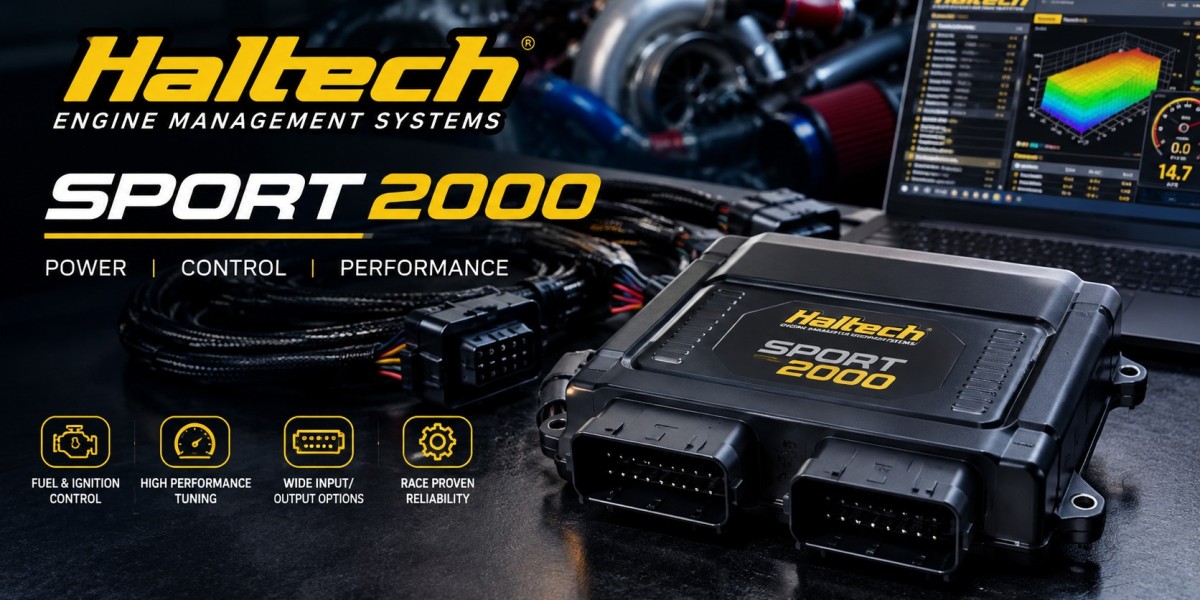

If you have spent any time around modified imports, drag cars, track builds, or engine swaps, you have probably heard someone mention the Haltech Sport 2000. Officially known as the Haltech Platinum Sport 2000, this programmable engine management system earned a strong reputation for giving tuners near professional control at a price that ordinary enthusiasts could reach. Even now, years after newer platforms arrived, the Sport 2000 still appears in project cars, engine swap builds and secondhand parts listings.
This guide explains what the Haltech Sport 2000 is, what it does, who it was designed for and how it compares with the modern ECU world. If you are evaluating one for a build, or you have inherited a car that already has one fitted, this is the foundation you need.
What Is the Haltech Sport 2000?
The Haltech Sport 2000 is a standalone ECU. That means it does not modify or piggyback on the factory computer; it replaces it. Instead of relying on the manufacturer's fixed calibration, the ECU gives you a blank canvas to decide how much fuel is delivered, when each spark fires, how boost is controlled and what happens when the engine reaches its limits.
The Platinum Sport line was released as a more accessible alternative to high end motorsport systems. Within the range, the Platinum Sport 1000 handled smaller engine layouts, while the Platinum Sport 2000 was the larger sibling, built for more cylinders, more outputs and more complex setups.
In simple terms, the Sport 2000 is a programmable engine control unit designed for
Turbocharged and supercharged builds
Naturally aspirated race engines
Engine swaps where the factory ECU is no longer suitable
Track, drag, drift and time attack cars
Custom builds where no plugin ECU exists
Why the Haltech Sport 2000 Became So Popular
Several things made the Sport 2000 stand out when it launched and they still explain why people talk about it today.
1. A generous number of channels. The Sport 2000 offers 14 channels that can be used for injection and ignition duties. That is a large pool for a mid-priced ECU and it is the reason the unit can handle so many engine layouts without needing add-on hardware.
2. Flexible cylinder support. Sequential injection is supported on engines with 4, 6, 8, 10 and 12 cylinders. Directfire ignition is supported up to 6 cylinders, while wasted spark ignition can be used on engines up to 12 cylinders. That range covers everything from a four cylinder turbo to a V8 or even more exotic layouts, including three rotor engines.
3. Serious feature depth. For a unit of its era and price class, the feature list was impressive. It includes closed loop boost control, closed loop idle control, wideband lambda control, boost by gear, two step rev limiting, antilag, flat shift, fan control and data logging. These are features many enthusiasts once had to pay much more for.
4. Approachable software. One reason the Sport line became popular was the tuning software. It presents fuel and ignition tables in a readable layout and it includes tools for autotuning using a target air fuel ratio table.
Understanding Standalone Engine Management
Before diving deeper into the Sport 2000, it helps to understand what a standalone engine management system does and why you might want one.
Every engine needs three basic things to run well: air, fuel and a spark at the right moment. The ECU measures how much air is entering the engine (using sensors such as a MAP sensor, throttle position sensor and air temperature sensor), then decides how long each injector should stay open and when each spark plug should fire.
A factory ECU is programmed for emissions, drivability, warranty and average driving conditions. It is not designed for a larger turbo, higher flow injectors, different camshafts, ethanol fuel, or a swapped engine. An aftermarket ECU like the Sport 2000 lets you rewrite those rules.
The benefits include
Precise fuel mapping across the entire rev and load range
Custom ignition timing to suit your fuel, compression ratio and boost
Boost control that can be tailored to gear, speed, or driver preference
Data logging so you can see what the engine is actually doing
Engine protection through limits for RPM, boost and other parameters
Key Specifications and Capabilities
Here is a practical overview of what the Haltech Sport 2000 offers.
Fuel control. Fully sequential injection is available across a wide cylinder range. Tuning can be approached through volumetric efficiency (VE) style mapping and the software supports an autotune approach based on a target AFR table when a wideband sensor is connected.
Ignition control. The ECU can operate multicoil systems, distributor based systems and aftermarket CDI setups. For direct fire ignition, the practical limit is six cylinders. For wasted spark systems, that limit rises to twelve.
MAP sensor. The ECU includes an onboard 2.5 bar MAP sensor and it can also be used with an external sensor for higher boost applications. That makes it flexible for both mild street turbo builds and more aggressive setups.
Boost control. Both open loop and closed loop boost control are supported, along with boost by gear. That last feature is especially useful for cars that struggle for traction in lower gears.
Idle control. Closed loop idle control helps keep the engine stable when cold, when the air conditioning cycles, or when electrical loads change.
Rev limiting and launch features. A two step rev limiter, soft and hard cut options, anti lag and flat shift features give drag and track users tools for consistent launches and clutchless upshifts.
Communication. The Sport 2000 uses CAN bus communication for connecting to compatible dashboards and data loggers. Documentation from dash manufacturers notes that the Sport 1000 and 2000 use Haltech's CAN protocols and that later firmware versions use the version 2 protocol. Keeping firmware updated is therefore a good idea if you plan to pair the ECU with a modern display.
Haltech Sport 2000 vs. Modern Haltech ECUs
It is worth being honest the Sport 2000 is an older platform. Haltech has since released its Elite and Nexus generations, which use newer software, faster processing, larger tables and broader CAN integration. If you are starting a new build today, you will probably find current generation hardware easier to support and you can browse the latest options in the Haltech product range and the new Haltech products section.
However, this does not make the Sport 2000 obsolete. Many cars still run reliably on it. If you already own one, or you find one in good condition, it can still be a capable performance engine management solution, especially for moderate power levels and well understood engine combinations.
Who Should Consider the Sport 2000?
Existing owners. If your project already has a Sport 2000 installed and running well, there is usually no reason to replace it unless you need features it does not offer.
Budget builders with a defined goal. A used unit with a good harness can be a cost effective route for a simple turbo conversion or a naturally aspirated build.
Restoration or period correct builds. Some owners want to preserve the original hardware in a car built during the Platinum era.
Tuners familiar with the software. Experienced tuners often prefer working with what they know.
Who Might Prefer a Newer ECU?
If you want modern touchscreen integration, large tables, fast CAN networking, drive by wire support, or extensive plug and play options, a current Haltech platform will probably serve you better. Many owners pair a modern ECU with digital displays for a clean, informative dash. Others add signal conditioners when they need to interface unusual sensors or trigger signals.
Common Applications
Turbo conversions. Taking a naturally aspirated engine and adding a turbo is one of the most common uses for a standalone ECU. The Sport 2000's boost control, wideband tuning, and flexible MAP sensing make it suitable for that path.
Engine swaps. When you put a different engine in a chassis, the factory ECU may not talk to the new engine at all. A programmable ECU removes that obstacle. Pair it with a proper wiring harness and you can get a clean, reliable installation.
Motorsport. Antilag, flat shift, launch features, and data logging are all valuable in competition. Drag racers and time attack drivers have long used the platform.
Multicylinder builds. Because the unit supports up to twelve cylinders in sequential injection, it opens options for V8 and larger engines that lowertier ECUs can't handle.
What You Need Alongside the ECU
An ECU is only one part of a working engine management system. To get the best results, you will also need
A wideband oxygen sensor and controller for accurate lambda readings
A quality crank and cam trigger setup that suits your engine
Correctly sized injectors and a fuel system that can support your target power
Reliable ignition coils and wiring
A properly built wiring harness with correct fusing and grounding
Tuning tools and a laptop with compatible software
For software, cables, and related accessories, see the tuning tools category.
Reliability and LongTerm Ownership
Good engine management is as much about the installation as the box itself. Poor grounds, weak power supplies, and low quality connectors cause more problems than any ECU fault. If you are running a Sport 2000, spend time on
Clean, short, well secured ground points
Sealed connectors in the engine bay
Shielded wiring for trigger signals
A dedicated switched power supply for the ECU and sensors
Regular inspection of the harness for chafing and heat damage
Software and firmware also matter. Because these ECUs are older, keep backups of your tune files and configuration, and store them in more than one place. If a laptop fails or a file is lost, a saved tune can save you hours of work.
Tips for Buying a Used Sport 2000
Confirm the ECU powers up and communicates with software
Ask for the last known tune file, and the firmware version
Inspect the connectors for bent pins or corrosion
Check whether a harness, sensors, and a programming cable are included
Verify that the unit was not wired with incorrect voltage or reversed polarity at any stage
A complete kit with a well made harness is worth more than a bare ECU, because a good harness takes time and skill to replicate.
Conclusion
The Haltech Sport 2000 earned its place in tuning history by offering a rare mix of flexibility, capability and affordability. With 14 channels, wide cylinder support, closed loop boost and idle control and a range of motorsport features, it turned standalone engine management from a specialist luxury into something enthusiasts could realistically use.
Today, it remains a solid choice for owners who already have one or who understand its limits. If you are planning something new, explore the current Haltech range at Arctic Performance Parts to compare modern options alongside supporting products like displays, harnesses and tuning tools. Whichever route you choose, remember the golden rule of engine management: a well planned installation and a careful tune will always matter more than any single spec on the box.
Frequently Asked Questions (FAQs)
What is the Haltech Sport 2000?
It is the Haltech Platinum Sport 2000, a programmable standalone ECU offering sequential fuel injection, ignition control, boost control, idle control and data logging for a wide range of engines.
How many cylinders does the Haltech Sport 2000 support?
It supports sequential injection on 4, 6, 8, 10 and 12 cylinder engines, direct fire ignition up to 6 cylinders and wasted spark ignition up to 12 cylinders.
Does the Sport 2000 have a builtin MAP sensor?
Yes. It includes an onboard 2.5 bar MAP sensor and can also work with an external MAP sensor for higher boost levels.
4. Can the Haltech Sport 2000 control boost?
Yes. It offers open loop and closed loop boost control, and it supports boost by gear.
5. Is the Sport 2000 still worth using today?
For existing installations and moderate builds, yes. For new projects requiring modern connectivity, larger tables, or drive by wire support, a current Haltech platform is usually the better choice.