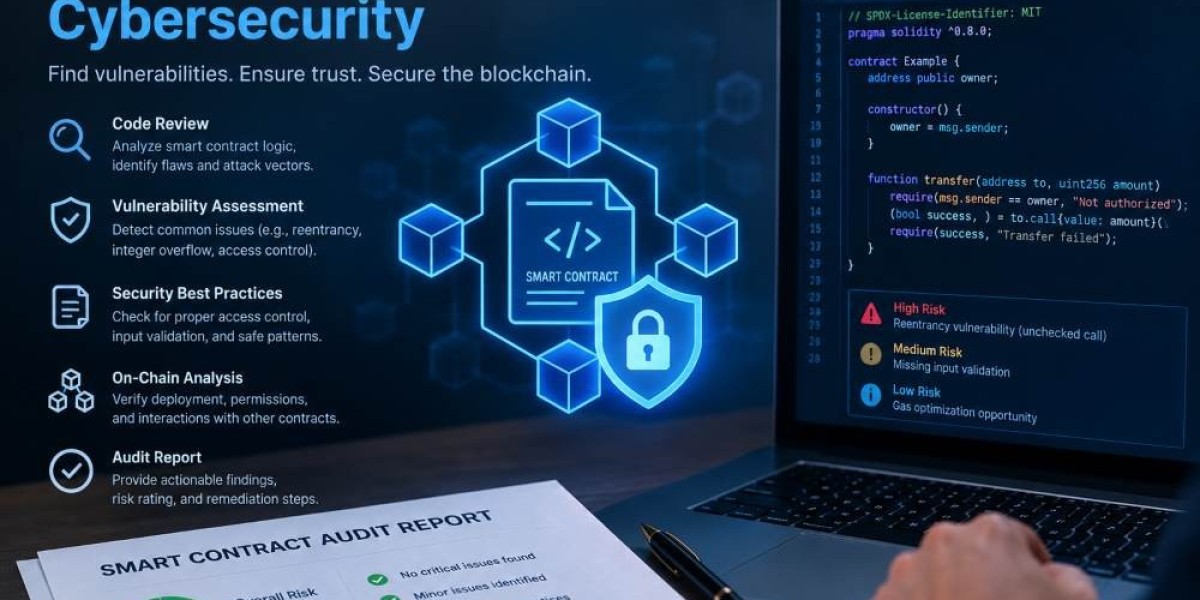

Smart Contract Auditing: A Complete Guide to Blockchain Security
Smart contracts are at the core of many blockchain applications, including DeFi platforms, token ecosystems, NFT marketplaces, DAOs, gaming applications, and Web3 infrastructure. These self-executing programs automate transactions and enforce predefined rules, but vulnerabilities in their code can expose applications and digital assets to serious security risks.
A professional smart contract audit helps identify security weaknesses before a contract is deployed or used in production. By combining automated security testing, manual code review, business-logic analysis, and vulnerability validation, organizations can gain a clearer understanding of the risks within their blockchain applications.
For projects handling valuable digital assets or critical transactions, smart contract security audit services can be an important part of a broader application security strategy.
What Is Smart Contract Auditing?
Smart contract auditing is the process of reviewing blockchain-based contract code to identify vulnerabilities, logical errors, design weaknesses, and potentially unsafe interactions.
Unlike conventional software, smart contracts can be difficult to modify after deployment. Depending on the architecture, an error in deployed code may be difficult or impossible to correct without an upgrade mechanism.
This makes security testing before deployment particularly important.
A comprehensive smart contract audit examines not only individual functions but also how contracts interact with users, other contracts, external services, tokens, oracles, and administrative systems.
Why Is a Smart Contract Security Audit Important?
Smart contracts can control funds, execute financial transactions, manage user balances, and enforce important business rules. A vulnerability can therefore have consequences beyond a simple software error.
A smart contract security audit can help development teams identify issues such as:
Access-control weaknesses
Reentrancy vulnerabilities
Incorrect business logic
Unsafe external calls
Oracle manipulation risks
Arithmetic and calculation errors
Improper input validation
Upgradeability issues
Initialization vulnerabilities
Denial-of-service conditions
Finding these issues before deployment gives development teams an opportunity to address them while changes are still manageable.
What Does a Smart Contract Audit Cover?
The exact scope of an audit depends on the project's architecture and requirements. However, a technical assessment commonly covers several major areas.
Source Code Review
Auditors analyze the contract's source code to understand how functions operate and how data moves through the system.
The review can focus on state changes, permissions, transaction logic, external calls, token handling, and other security-sensitive operations.
Business Logic Analysis
A contract may be technically valid while still implementing an incorrect business rule.
For example, a rewards mechanism may calculate values incorrectly, or a withdrawal function may allow a user to bypass an intended restriction.
Manual business-logic analysis helps determine whether the actual implementation matches the project's intended functionality.
Access Control Review
Privileged functions require strong authorization controls.
During a smart contract audit, security professionals can examine ownership mechanisms, role-based permissions, administrative functions, modifiers, and privileged addresses.
The objective is to determine whether unauthorized accounts could gain access to sensitive functionality.
External Contract Interactions
Blockchain applications often depend on other smart contracts and protocols.
Auditors review external calls, dependencies, callbacks, return values, and assumptions about third-party contracts to identify potential security risks.
Manual Review and Automated Smart Contract Testing
Automated security tools can quickly identify common vulnerability patterns and suspicious code structures. They can be particularly useful for large codebases and repetitive security checks.
However, automated tools cannot always understand application-specific business logic or complex interactions between multiple contracts.
For this reason, a reliable smart contract security audit should combine automated analysis with manual review.
Security teams may use techniques such as:
Static analysis
Dynamic testing
Fuzz testing
Symbolic analysis
Manual code review
Custom security scripts
Controlled proof-of-concept testing
Using multiple testing techniques can provide broader coverage than relying on a single security tool.
Common Smart Contract Vulnerabilities
Smart contract vulnerabilities vary according to the application's architecture, but several security categories deserve particular attention.
Reentrancy
Reentrancy occurs when an external interaction allows a contract function to be called again before the original execution has safely completed.
Auditors examine external calls and state-management logic to determine whether sensitive functions could be abused through repeated execution.
Access-Control Vulnerabilities
Incorrect permissions can allow unauthorized users to execute administrative operations.
A security assessment should verify who can change contract settings, transfer ownership, upgrade implementations, mint tokens, withdraw funds, or perform other privileged actions.
Oracle Manipulation
Many DeFi applications rely on external data such as asset prices.
If the contract receives manipulated or unreliable data, an attacker may potentially influence calculations or financial operations.
Oracle dependencies should therefore be carefully reviewed during a smart contract audit.
Logic Vulnerabilities
Some of the most difficult issues involve application-specific business logic.
A contract may execute correctly from a programming perspective while still allowing users to achieve an outcome that was never intended by the project.
This is why understanding documentation and business requirements is an important part of security auditing.
Upgradeability Issues
Upgradeable contracts introduce additional administrative and technical considerations.
Auditors should review proxy architecture, implementation contracts, upgrade permissions, initialization functions, and privileged roles.
The Smart Contract Audit Process
A structured audit methodology helps ensure that security testing is consistent and comprehensive.
1. Scope Definition
The audit begins by identifying the contracts and components that will be reviewed.
The security team may collect source code, architecture documentation, dependency information, deployment details, and information about known limitations.
2. Architecture Analysis
Auditors study how the contracts interact with each other and with external systems.
This provides context for understanding possible attack paths and dependencies.
3. Automated Analysis
Security tools are used to identify common vulnerability patterns and potential areas requiring additional investigation.
4. Manual Review
Experienced security professionals analyze the source code and business logic in detail.
This stage can identify vulnerabilities that automated scanners may not recognize.
5. Security Testing
Critical functions and attack scenarios are tested using appropriate techniques, including fuzzing and controlled security testing where applicable.
6. Reporting
Findings are documented with technical explanations, affected components, severity information, and remediation recommendations.
7. Remediation and Retesting
After developers address identified issues, a follow-up review can verify whether the vulnerabilities have been properly resolved.
What Is Included in a Smart Contract Audit Report?
A professional audit report should provide clear information about the security assessment and its findings.
A typical report may include:
Executive summary
Audit scope
Methodology
Contract architecture
Findings
Severity classifications
Technical descriptions
Affected functions
Recommended remediation
Retest results
Final security observations
A well-structured report helps developers understand what needs to be fixed and helps stakeholders understand the project's security status.
When Should You Perform a Smart Contract Audit?
Ideally, a smart contract audit should be performed before critical contracts are deployed to production.
Security testing can also be performed during development to identify architectural issues early. A final assessment can then focus on the production-ready code.
Additional reviews may be appropriate after significant changes, upgrades, new integrations, or modifications to important business logic.
Preparing for a Smart Contract Security Audit
Development teams can make the audit process more efficient by preparing the required technical information before testing begins.
Teams should provide the latest source code, project documentation, architecture diagrams, dependencies, deployment information, and details about privileged accounts.
It is also important to maintain version control throughout the assessment so that the audit findings clearly correspond to the code that was reviewed.
Smart Contract Security and Broader Cybersecurity
Smart contracts rarely operate in isolation. A blockchain application may also include websites, APIs, authentication systems, cloud infrastructure, wallets, administrative interfaces, and third-party integrations.
As a result, contract-level security should be considered alongside broader cybersecurity testing.
For organizations that want to evaluate how attackers could move across connected systems, red team services can complement smart contract-focused security testing by simulating realistic attack paths across people, processes, and technology. FemtoSec's red team methodology uses threat intelligence and adversary simulation mapped to the MITRE ATT&CK framework.
This broader approach can help organizations understand how vulnerabilities in different components could potentially interact.
Benefits of Professional Smart Contract Auditing
A structured smart contract security audit can provide several practical benefits for blockchain development teams.
It can help identify vulnerabilities before deployment, improve code quality, validate security assumptions, and provide developers with clear remediation guidance.
An audit can also give project stakeholders greater visibility into the security risks associated with the reviewed codebase.
However, an audit should not be treated as a permanent guarantee of security. Changes to the code, architecture, dependencies, or external integrations can introduce new risks that require additional assessment.
Smart Contract Security as an Ongoing Process
Blockchain security should continue after the initial audit.
Development teams should monitor important changes, review new functionality, protect privileged accounts, and reassess security when major updates are introduced.
If a contract is upgraded or substantially modified, the previous audit may no longer represent the security characteristics of the new implementation.
Continuous security practices can therefore complement periodic smart contract auditing and help projects respond to changing attack surfaces.
Conclusion
A professional smart contract audit provides a structured way to examine blockchain code for vulnerabilities, logic flaws, access-control weaknesses, unsafe interactions, and other security risks.
A comprehensive smart contract security audit combines automated analysis with manual code review, business-logic testing, vulnerability validation, reporting, and remediation verification.
For blockchain projects that manage digital assets or execute critical transactions, integrating smart contract security into the development lifecycle can help identify weaknesses before they become real-world security problems.
When combined with broader application and adversary-focused testing, smart contract auditing can form an important part of a comprehensive cybersecurity strategy for modern Web3 applications.